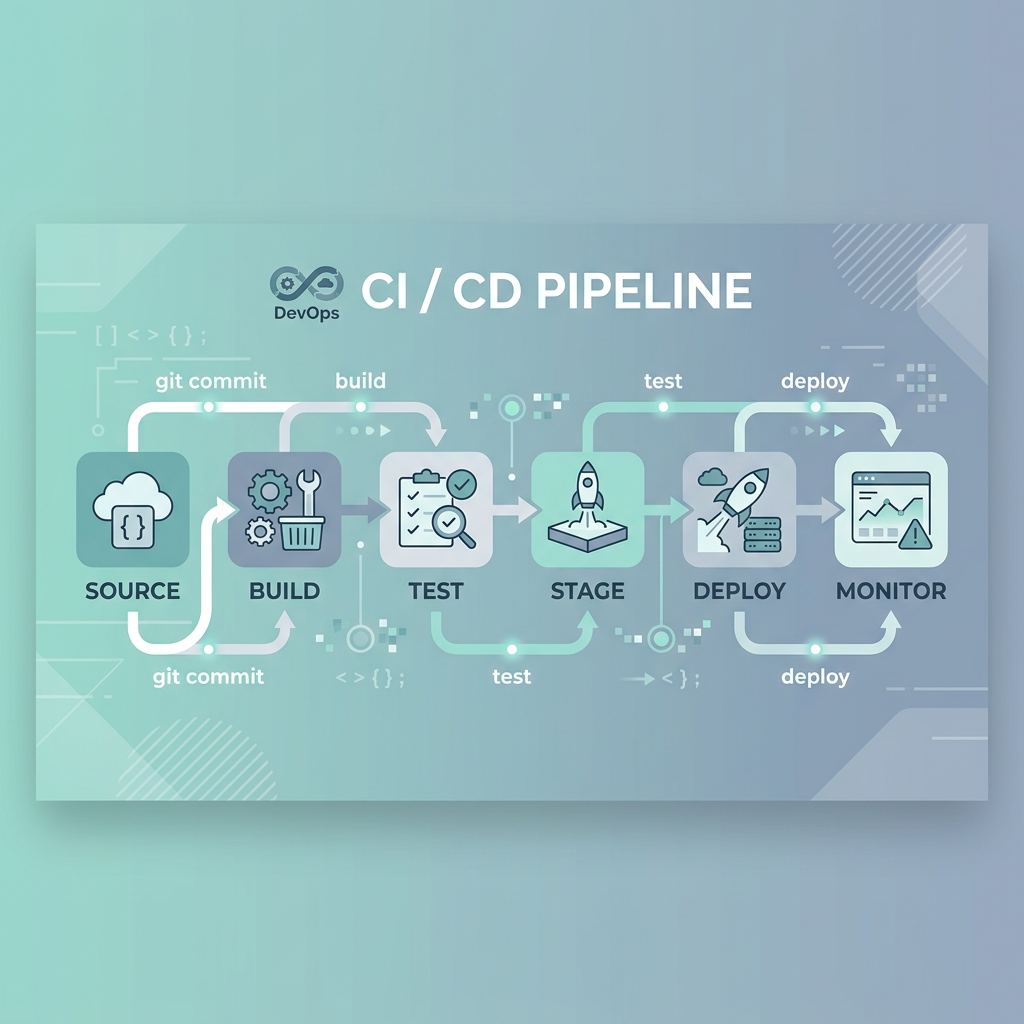
Modern software delivery demands more than just fast pipelines. Here are the proven DevOps and CI/CD strategies that high-performing engineering teams are using to ship better software, faster.
The pace of software delivery has never been faster — or more consequential. Engineering teams that invest in robust CI/CD pipelines and DevOps culture consistently outperform their peers across every measurable dimension: deployment frequency, change failure rate, and recovery time.
Pipeline Architecture Fundamentals
A great CI/CD pipeline is more than a sequence of scripts. It's a system designed around fast feedback, security, and repeatability. Start with trunk-based development to minimize integration friction, then layer in automated testing at every stage — unit, integration, contract, and end-to-end.
Shift-Left Security (DevSecOps)
Security can no longer be an afterthought bolted on at the end of the pipeline. Shift-left means embedding security scanning — static analysis (SAST), dependency auditing, and container image scanning — into every pull request. Tools like Trivy, Snyk, and SonarQube integrate seamlessly with modern CI platforms.
Observability and Feedback Loops
A deployment that can't be observed is a liability. Implement distributed tracing, structured logging, and real-time alerting from day one. The signal-to-noise ratio of your alerts is critical — alert fatigue leads to missed incidents.
Infrastructure as Code
Every infrastructure change should flow through version control. Terraform, Pulumi, and AWS CDK enable teams to apply the same rigor to infrastructure that they apply to application code — review, test, and rollback.
BIORBIT's Approach
Our DevOps practice focuses on building these capabilities sustainably. We work with client engineering teams to assess current maturity, identify the highest-leverage improvements, and implement them iteratively — without disrupting ongoing delivery.